Cellular thermodynamics is the first-order force
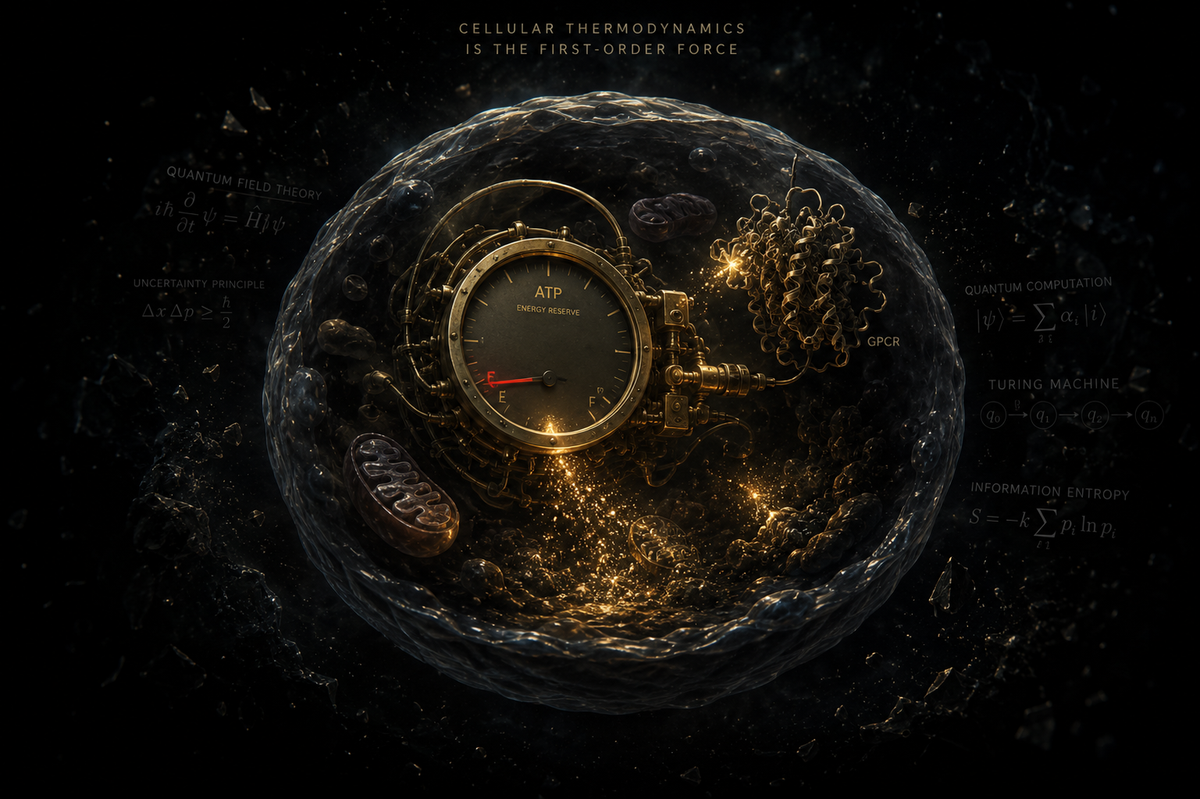
Cellular thermodynamics is the first-order force
Because no theory of cognition — quantum or computational — survives without first settling the bill in ATP.
There's a growing debate in biology about how far "cognition" really extends. Bacteria that "decide" which way to swim. Slime molds that "solve" mazes. Isolated cells that, according to some, process reward signals the same way a neuron processes dopamine. The field is called basal cognition, and it has serious names behind it — Pamela Lyon, Michael Levin, among others — publishing in respected journals.
The question this piece raises isn't whether basal cognition exists. It's narrower, and for that reason more uncomfortable: could the classical molecular machinery we use to explain reward in animals — G-protein-coupled receptors (GPCRs), the same family that mediates dopamine — really be the substrate for this phenomenon in a single, isolated cell, with no network around it?
The answer, once you look at the bioenergetics without sentimentality, is no. And the reason is brutally simple: all of this costs ATP, and the cell has no budget for spending without return.
The bill nobody runs
A GPCR receptor isn't born free. Every amino acid in its chain costs four high-energy phosphate equivalents just to be translated by the ribosome. A typical receptor, spanning 400 to 450 amino acids, consumes between 1,600 and 1,800 units of ATP/GTP in assembly alone — and this is the most conservative estimate possible, before accounting for gene transcription, mRNA processing, post-translational modifications, and the work of the translocation machinery that inserts the receptor into the membrane.
Once built, the receptor doesn't sit in the membrane for free. It demands continuous maintenance: the electrochemical gradients that sustain its ability to signal depend on the Na⁺/K⁺-ATPase pump — the same one Jens Skou described in 1957, which alone consumes between 20% and 40% of the cell's entire energy budget at rest.
An isolated cell, with no nervous tissue around it, no network to convert a dopamine signal into a survival advantage, has no way to justify this expense. Natural selection doesn't fix expensive machinery "just in case" — it fixes what pays for itself.
Two schools, the same blind spot
The most interesting part of this argument isn't attacking one specific theory — it's noticing that two rival explanatory traditions, which disagree about almost everything, make exactly the same mistake.
On one side, models that place the relevant computation at the level of quantum coherence in cellular structures (the Orch-OR model, from Hameroff and Penrose). On the other, purely computational models, where dopamine encodes a prediction-error term in a reinforcement-learning algorithm (the classical formalization by Schultz, Dayan, and Montague, now extended into basal cognition). These are schools that disagree on whether there's a "hard problem" of consciousness, on whether qualia do any causal work, on practically everything.
But neither answers: how much does it cost, in ATP, to build and maintain the machinery that runs that computation — quantum or computational — in a cell with no network? A model of quantum coherence doesn't say whether the receptor needed to couple that coherence to a behavioral output is metabolically sustainable. A computational model doesn't say whether synthesizing the apparatus that computes "value" is energetically viable outside a network that converts it into a survival advantage.
Both schools operate at the level of information. Neither operates at the level of ATP.
Not a refutation — a constraint
It's worth being precise here: this doesn't deny that basal cognition exists. Bacteria do perform chemotaxis. Physarum polycephalum does solve mazes. That's well documented and not in dispute.
What bioenergetics constrains is the space of plausible molecular mechanisms for explaining these phenomena. A GPCR-class receptor — expensive, complex, dependent on costly ionic gradients — isn't a plausible candidate for an isolated cell. If basal cognition is real (and it probably is), the molecular substrate has to be something else: cheaper, more direct, more compatible with the energy budget of a single cell with no supporting network.
This is the central proposal: any candidate mechanism — quantum, computational, or whatever comes next — needs to answer to this constraint, not work around it.
What remains
Perhaps the simplest lesson here is also the most uncomfortable one: theoretical enthusiasm doesn't pay ATP bills. Before asking whether a cell "feels," "decides," or "computes," it's worth asking whether it would have any energy left over to do any of those things — and, more often than we'd like to admit, the answer is no.
This essay summarizes the central argument of a theoretical article submitted to the journal Animal Cognition (Springer Nature), currently under review. The preprint, with the full analysis and references, will shortly be available on Research Square, with its own DOI.