The boundeless Prision - Book I
But on that morning of September the second she looked at her fifty-year-old husband with the golden watch in his hand and felt both things at once — the most complete love she had ever felt, and the deepest fear she had ever carried.
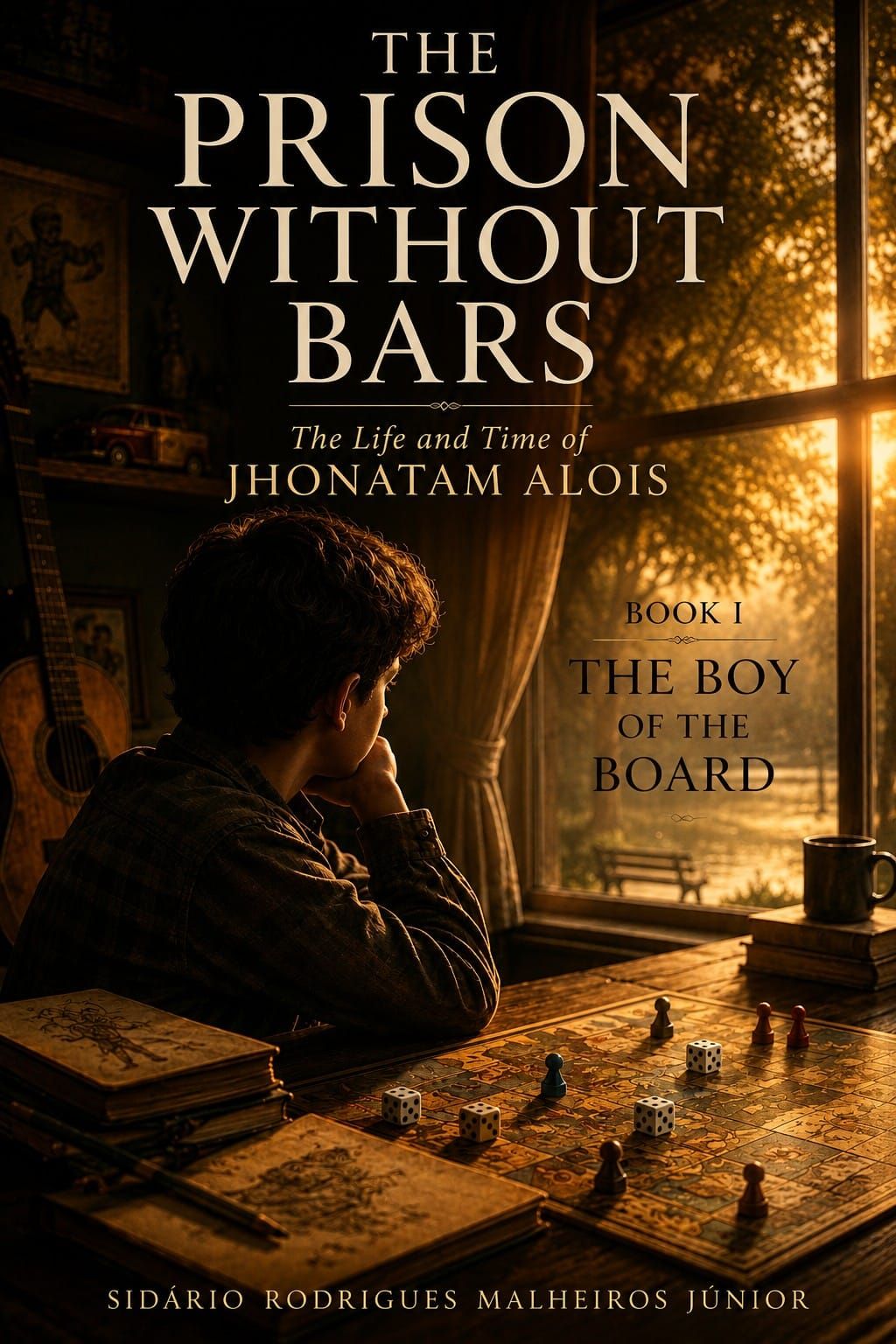
The life of jhonatan Alois
S. R. Malheiros Júnior
"He comes to exist as the book he wrote.
But incapable of writing the next chapter."
Chapter 1 — The Boy with the Dice
Jhonatan Alois learned before anything else that time moved.
Not through clocks — he barely paid attention to them. He learned through dice. Through the dry sound they made falling against the wooden table, through the suspended instant before they settled, when everything was still possible and nothing had been decided. It was in that interval — between the throw and the landing — that Jhonatan lived with more intensity than anywhere else.
He was eight years old when he built his first board. It wasn't from any box, didn't follow any printed rules. It was his. Paths he drew himself with a ruler and pencil on a sheet of kraft paper, numbered squares, territories with names he invented, characters who had stories before the game even began. The dice didn't just decide how many squares to move. They decided what happened. Three meant storm. Five meant encounter. One meant loss.
He played alone most of the time.
This never bothered him.
There was something others didn't understand — that playing alone wasn't the absence of company. It was the freedom to create two complete characters, to inhabit both at once, to feel the tension between them without having to explain the rules to anyone. The same board yielded different outcomes with every game. The same story never repeated itself. And it was exactly this that gave Jhonatan a feeling he wouldn't be able to name for many years — the feeling that life was vast, that paths multiplied, that there was always another possible move.
On Sundays he went to his grandmother's house.
It was the only place outside his own room where he felt completely inside himself. His grandmother didn't ask too many questions. She let him set up the board on the kitchen table while the smell of lunch filled the house, let the few neighborhood friends come in and sit around without ceremony. There were three of them, sometimes four. Few. Jhonatan didn't need more. He needed people who understood that the dice were serious, that the character mattered, that the outcome of a game could be a whole story told in forty minutes.
Outside of that — at school, on the way there, in the noisy recesses — he was the quiet boy.
Tall for his age, dark hair, a presence people noticed without quite understanding why. Girls looked at him. He didn't notice, or noticed and pretended not to. There was in him a shyness that wasn't insecurity — it was distance. As if he were always slightly displaced from the present moment, inhabiting some internal place where things made more sense than out there.
The guitar came shortly after the dice.
First the Conservatory — his mother took him, he went without resisting, and discovered in the first lesson that music worked like the board. It had rules, it had progression, it had an internal time that moved. But it was more alive than kraft paper. More unpredictable. A melody could go down paths the score didn't anticipate if the fingers knew how to listen to what the next note asked for.
Jhonatan listened.
By twelve he was pulling from the guitar things that teachers asked him to repeat more slowly, just to understand where they came from. He couldn't explain it. His fingers knew. It was an intelligence that lived in his hands, that didn't pass through his head, that existed in a place prior to words.
He wouldn't know, in that time, how much that would matter.
He wouldn't know that there would come a day when everything else was gone — the names, the faces, the way home — and that place prior to words would be the last to resist.
For now he was just a boy.
Throwing dice on a wooden table.
Waiting for the instant when everything was still possible to land and show what had been decided.
Chapter 2 — The Ground That Gave Way
His mother called him on an ordinary afternoon.
There was nothing extraordinary about that day — the sun came through the window the same way, the smell of the house was the same, the guitar was in the corner of the room where it always was. Jhonatan sat in the kitchen chair and looked at her, and knew before any words that what was coming would change something. He didn't know what. He knew it would change.
She spoke about the divorce with the voice of someone who had rehearsed and still hadn't found the right tone. She said their lives would change significantly. That there would be less. Less of what she didn't need to specify — Jhonatan was already doing the math in the silence between one sentence and the next. Less space. Less margin. Less future projected with the breadth he had always imagined it would have.
And then she said — with care, with love, with the delicacy of someone who doesn't want to hurt but needs to be honest — that perhaps his plans would need to change. Not disappear. Just become different.
Jhonatan listened.
He didn't cry. He didn't protest. He sat looking at his mother with that quiet attention he had always had — the same as when the dice were still in the air, when everything was still possible and he waited for the landing with his whole body. Only this time he knew which face would appear before he even saw it.
He nodded.
And went back to his room.
* * *
There was a universe where he was a doctor. One where he was an engineer. One — his favorite, the vastest — where he studied space, understood the physics of rockets, lived inside the question of what lay beyond what eyes could reach. These universes didn't disappear that afternoon. Jhonatan knew, with the strange clarity that sometimes inhabited very quiet boys, that parallel universes don't get destroyed — they simply become inaccessible. They stay there. On the other side of a door that reality closes without ceremony.
University wasn't a course. It was the door.
And the door had closed.
* * *
The technical course in mechanics came without drama. Jhonatan chose with the same logic he used when playing — assessed the board, saw which paths were open, chose what made the most sense within the imposed reality. There was no heroism in it. No tragic resignation. There was simply a young man who had learned from the dice that the outcome isn't always what you want — and that the skill isn't in controlling the throw, but in playing well with what falls.
He was good with his hands. Always had been — the guitar had proven that. Mechanics demanded the same intelligence that lived in his fingers, the kind that didn't pass through his head, that understood how things worked from the inside before any manual could explain it. Engines had a logic. Jhonatan listened to that logic the way he listened to music — with attention to what the next piece needed.
The garage workshop started at home.
An improvised workbench, some tools, the neighborhood people who needed someone trustworthy. Jhonatan worked in silence and well, and his reputation grew before his space did. Soon the garage wasn't enough. Soon there were employees, equipment, a proper address. Soon there was a workshop the whole city knew — not because Jhonatan promoted himself, but because he did what he said he would do, understood the why behind every problem, and treated each car with the same attention he gave the characters of his board games.
It seemed Jhonatan would be good at whatever he did.
And it was true. But there was a version of him — the doctor, the engineer, the man who studied space — that existed only in that internal place where things stay without needing to be spoken. Kept in the same space as the incomplete melodies, the chords his fingers knew and memory sometimes forgot.
He never spoke about it.
Never did.
Only sometimes — in a quiet night, with the guitar in his lap and no melody arriving whole — there was something in Jhonatan's face that seemed less like longing for a past and more like longing for a future that had never come to be.
A future that had stayed on the other side of the door.
In a universe he knew existed.
And had learned, on an ordinary sunny afternoon, wasn't his.
Chapter 3 — Clara
Jhonatan was twenty-three years old and had a workshop the whole city knew.
He had arrived somewhere that wasn't what he had dreamed — and had made peace with that in a way few people manage. It wasn't conformism. It was lucidity. Life had given him a different board than the one he had drawn in childhood, and he had played well. Better than well. He had prospered through the intelligence of his hands, through the quiet attention he gave to everything, through the honesty of someone who never promised what he couldn't deliver. He was happy — not with the noisy happiness of someone who needs to convince others, but with that other kind, quieter and deeper, of someone who looks at their own life and recognizes something true in it.
There was one thing missing.
He knew what it was. Had known for years. Had known since the new neighborhood, since the first times he had seen her pass by, since the Sundays when he calculated the chances of running into her at the bakery and pretended he was going to buy bread.
Clara.
* * *
That Sunday mass ended like all the others — the priest, the final blessing, the sound of wooden pews scraping as the nave emptied. Jhonatan left through the side, saw her near the door, and did what dice sometimes demand — he threw without knowing what would fall.
He walked up to her.
— Hi, Clara. I'm Jhonatan. I don't know if you've noticed, but we've lived in the same neighborhood for twenty-five years.
She turned. Looked at him with those eyes he had known from a distance for so long and that up close were even more direct than he expected. And smiled — not the polite smile of someone who doesn't know the name, but the smile of someone who had been waiting for someone to find the courage.
— Of course I know who you are. I also know we've lived in the same neighborhood for twenty-five years.
Jhonatan stood still for a second.
Twenty-five years. Both knowing. Both waiting. And one sentence was enough to undo all of that.
They left the church together without planning it. Walked to the square without deciding. Sat on a bench and began talking about life with the strange naturalness of people who have known each other a long time and are only now discovering each other. She asked about the workshop. He told her — without modesty, without exaggeration, with the same precision he used to explain an engine problem. She listened in a way few people listened to Jhonatan — without hurry, without the next sentence already prepared, as if what he said genuinely mattered.
At some point she said there was still time. That he was still young. That he could be whatever he wanted.
Jhonatan looked at her.
— My reality today is different, Clara. I have to take care of my mother. I'm the one keeping the house. — A short pause. — But look where I've gotten within that reality. It's not what I projected. It's better than I expected.
She didn't respond with words. She simply nodded — with the seriousness of someone who understands that a well-lived life doesn't need to follow the original script to be true.
They stayed in the square until the sun went down.
* * *
The picnic came months later.
In a spring that Jhonatan would keep forever — not for the date, not for the place, but for the quality of the air that day, for the way the light fell over the park, for the feeling that time had slowed down on purpose to let that moment last longer than the others.
He had prepared what he wanted to say. Rehearsed versions. Discarded them all.
In the end he told the truth, which was the only version that had always worked.
— I always noticed you. From the beginning. I was too shy to say it. But you've always been the woman of my life — even before I knew what that meant.
Clara was quiet for a moment.
Then she came closer. Closed her eyes.
And Jhonatan — the boy with the dice, the boy who had learned that every throw defines what comes next — understood that he had thrown the most important one of all. And that it had landed the best way possible.
He closed his eyes too.
And kissed her.
* * *
It was spring.
And the thread that formed there — between Jhonatan and Clara, in that park, in that kiss — would be the only one that life would never be able to completely unravel.
Not even when everything else was gone.
Chapter 4 — Her Castle
They didn't plan their life. It happened with the naturalness of people who already know the way and only needed the other to begin walking.
Clara came into the workshop through the accounts — she had a clarity with numbers, organized what Jhonatan left to accumulate for lack of time — and stayed for everything else. The engagement came without excessive ceremony. The wedding came with her radiant and him in a suit, uncomfortable with the tie but unable to take it off because she had chosen that tie. The children came in three — each one with something of Jhonatan in their silence and something of Clara in the way they occupied space.
The house grew with them.
Not quickly. Solidly. The difference between the two was something Jhonatan understood instinctively — he had learned at the workshop that what lasts isn't what goes fast, it's what is made with attention. Each year added something. Each decision was made with both of them present, with the accounts on the table and the future being drawn out loud.
Clara cared for the house with the same dedication Jhonatan gave to engines — with attention to detail, with the certainty that the small things matter, with the understanding that a home isn't a structure but a climate. And the climate of that house was peace. The specific peace of two people who chose well and know it.
The children grew up inside that peace without knowing how to name the privilege it was.
* * *
On their tenth wedding anniversary Jhonatan was thirty-five years old and had a secret kept for months.
Clara had spoken about Disney for as long as he could remember — with that lightness of someone who doesn't demand but dreams out loud. The castles, the princesses, the specific magic of a place built entirely to make people believe the impossible has an address. She talked about it and laughed at herself for talking, as if the dream were too big to be taken seriously.
Jhonatan took it seriously.
He saved in silence. Got the documents without telling her. Planned with the precision of someone diagnosing an engine — identifying each necessary piece, each step in the right order. And on an anniversary morning he placed an envelope with the tickets in front of her and waited.
Clara opened it slowly.
Read.
Looked at him.
And took a few seconds to be able to speak — not because words were lacking, but because there were too many words and none of them were sufficient.
* * *
Orlando in July.
Clara walked through the park with that expression Jhonatan captured in every detail — her eyes wider than usual, the smile that appeared and disappeared and came back without her noticing, the way she stopped in front of the castle and just stood there, looking, as if she needed time to believe it was real.
He stayed a step behind sometimes. Just to watch.
One afternoon she turned to him in the middle of the park, for no apparent reason, and spoke with a seriousness that contrasted with everything around them — the balloons, the music, the children running.
— I will never forget what you did for me. There is nothing in this world that will make me forget.
Jhonatan heard that and felt something settle inside him — like a piece finding the exact fit after a long time out of place.
That night, in the hotel room, he looked at the ceiling for a while before sleeping. He thought about the boy with the dice. About the boy who dreamed of rockets and space and vast futures. He thought about his parents' divorce, about the afternoon the ground gave way, about the door that had closed.
And he thought that perhaps the dice had known what they were doing.
That perhaps the path that seemed a detour was the path.
That the castle he had built wasn't made of stone or fantasy — it was made of years, of choices, of a woman who slept beside him and had said she would never forget.
He looked at himself in the mirror before sleeping.
And recognized the man he saw.
Not the doctor. Not the engineer. Not the astronaut.
The Jhonatan who had arrived where he needed to arrive — within what life had allowed, within what he had built with his own hands, within the love he had chosen and that had chosen him back.
It was enough.
It was more than enough.
Chapter 5 — Incomplete Melodies
The guitar stayed in a corner of the room.
It wasn't abandonment — it was a silent presence. Like an object that has already fulfilled its most urgent function and now exists differently, less necessary but no less true. Jhonatan passed by it every day without stopping. And every day there was a moment — brief, almost imperceptible — when his eyes settled on the instrument and something moved inside him before he kept going.
Sometimes he picked it up.
He sat on the edge of the bed or in the chair near the window, put the guitar in his lap with the automatic gesture of someone who had done it a thousand times, and began to search. His fingers looked for chords that memory wouldn't deliver whole. Fragments came — the beginning of a melody he had played at twelve, the progression of a piece he had learned at the Conservatory, a sequence of notes that belonged to something larger he could no longer reconstruct. He'd get so far. Stop. Try another path. Stop again.
It wasn't frustration. It was archaeology.
He excavated his own musical memory with the patience of someone who knows the things are there — only in places that disuse had made hard to reach. He would need time, practice, to go back to living inside it. And Jhonatan didn't have time — there was the workshop, there were the children, there was Clara, there was the whole life he had built that demanded constant presence.
The guitar went back to the corner.
The melodies stayed incomplete.
* * *
But there was the car.
On the drive from home to the workshop — twenty minutes of familiar streets, the same traffic lights, the neighborhood passing the window with the familiarity of breathing — Jhonatan put on music and the world changed texture. Not just any music. The kind that had lived inside him since childhood, the kind his Conservatory teachers played, the kind he discovered on his own and kept with the care of someone who knows the value of what they've found.
In those twenty minutes he wasn't a father. Wasn't a husband. Wasn't a workshop owner, the city's reference, the man others came to when they needed someone reliable.
He was just Jhonatan.
The one who felt without needing to explain. The one who existed before all the roles. The one who was left from the quiet boy who threw dice and listened to the next note with attention to what it asked for.
Music was the only space where that still fit whole.
* * *
At night, when the house was quiet and Clara was already sleeping, he sometimes stayed in the living room with the volume low and a song she had put on at dinner still circling inside him. In those moments there was a specific quality to the silence — not empty, but full of something that didn't need a name.
Jhonatan didn't call it happiness.
He called it peace.
The difference, he had learned over the years, was that happiness comes and goes. Peace stays — in one form or another, even when circumstances change, even when the ground gives way, even when the dice fall in a way nobody expected.
He didn't know, in those quiet nights, that there would be a time when music would be more than peace.
It would be a door.
It would be the only way back inside himself when all the other doors were closed.
For now it was just the sound playing softly while the house slept.
And Jhonatan listened.
As he always had.
With attention to what the next note asked for.
Chapter 6 — The Adventure Book
Clara had a way of keeping things that Jhonatan took years to fully understand.
She didn't keep objects — she kept moments. The difference was subtle but it was everything. An object can be lost, forgotten, discarded. A moment recorded with intention becomes something else — it becomes proof that it happened, that they were real, that time passed through there and left a mark.
It was she who started the book.
She brought it on an ordinary afternoon — hard cover, thick pages, the kind of book that suggests permanence. She put it on the table in front of Jhonatan and said she wanted to keep their adventures in a way that couldn't fit only in memory.
He looked at the book. Looked at her.
And understood.
* * *
The rule was simple and it was theirs.
After each trip, after each experience worth keeping, Jhonatan chose a photo — sometimes two, never more than three — and glued it to the pages with the care of someone who knows framing matters. Then he wrote by hand. Not a report, not a caption. He wrote what he had felt in that specific moment — what the air smelled like, what Clara had said that he didn't want to forget, what had happened unexpectedly, what had confirmed something he already knew but needed to see from outside to recognize.
Then he passed the book to Clara.
She read what he had written. And completed it — with her own view, with what she had felt in the same moment, with the detail he had missed because he was looking another way. The same scene seen through two pairs of eyes. The same instant inhabited from two different places.
She signed below.
He signed below her signature.
* * *
The book grew slowly — which was the only way worth growing.
There was the Disney page, with Clara in front of the castle and Jhonatan's handwriting describing her expression with a precision the photo alone couldn't capture. There was the page of a road trip that had gone wrong in a way that became funny only afterward — a flat tire on a road without signal, the two of them sitting on the shoulder eating the snack she had brought just in case, laughing at something that wasn't funny at the time. There were pages of dinners, of squares in cities they had visited, of mornings in hotels where the coffee was bad but the view made up for it.
There was one page without a photo.
Just text — Jhonatan's handwriting filling the whole page, cramped, as if the words didn't fit in the normal space. It was about a night at home, no trip, no event. A night when the children had fallen asleep early and the two of them had stayed on the porch until late talking about nothing and everything, and Jhonatan had looked at her in a moment and thought — with the sudden clarity that sometimes arrives without warning — that this was it. That there was nothing more to look for. That he was completely in the right place.
Clara had read that page three times before she could write hers.
She signed with a hand that trembled slightly.
* * *
With the children grown the book gained speed.
There was more time now — more space for adventure, more room to say yes when a trip came up, more lightness in planning without the logistics of small children. Jhonatan and Clara traveled as if making up for the years when the schedule hadn't allowed it — not in a hurry, but with appetite. Europe in stages. Brazilian cities they had never had time to properly explore. A cruise Clara had wanted for years and Jhonatan had resisted until he understood the resistance was foolishness.
Each place became a page.
Each page became a conversation — because re-reading the book together had become a ritual of its own. On any given night one of them would take the book from the shelf, open to a random page, and begin reading aloud. The other would listen and remember — and what they remembered was always slightly different from what was written, and the difference became a conversation, and the conversation lasted longer than planned, and both went to sleep later than they should have.
The book had become their external memory.
The place where time was kept with care — in handwriting, in photos, in signatures.
Jhonatan didn't know, when he glued each photo with the care of someone who knows framing matters, that there would come a day when those pages would be the only way back inside himself.
That Clara would open the book not to remember — but to rescue.
That the stories he had written with his own hands would be read to him out loud as if they belonged to a stranger — and that even so, in some place prior to memory and prior to words, something inside him would recognize the smell of those pages.
The weight of that book in his hands.
Clara's voice reading what he had written.
For now it was just a book on a shelf.
Waiting to be opened.
Chapter 7 — The Wallet in the Trash
Jhonatan was forty-eight years old when he threw his wallet in the trash.
He didn't notice. That was the detail — there was no visible distraction, no extreme tiredness, nothing that explained it. He was in the kitchen, picked up the wallet from the counter as he did every day before leaving, and in a gesture his body executed with its usual naturalness deposited it in the trash can beside the sink instead of his pocket.
He left the house.
Walked to the lottery office at his usual pace — hands in his pockets, the neighborhood passing with the familiarity of breathing. Arrived. Opened his pocket. And stood in line with his hand inside a void that shouldn't have been a void.
He went home laughing.
Told Clara with the tone of someone who has a good story to tell — and it was that, still only that, a good story, an unexplained distraction that happens to everyone on ordinary days. Clara laughed with him. Said — next time you throw something away, throw it in my trash. They laughed more. It was the kind of episode that enters a couple's repertoire, that becomes a reference, that comes up years later at a dinner table as an example of how everyday life is funny when you let it be.
Jhonatan went to the lottery office the next day.
Paid the bills. Went home. Everything normal.
* * *
The shoes in the refrigerator happened three weeks later.
Clara opened it to get the morning juice and stood looking for a moment without understanding what she was seeing — Jhonatan's pair of shoes, perfectly positioned on the middle shelf, between the juice and the cheese. She called for him with a voice that tried to be light and wasn't completely.
— Sweetheart. Why are your shoes in the refrigerator?
He came to the kitchen. Looked. And laughed — with the same naturalness as before, with the same tone of someone recognizing their own absent-mindedness and finding it funny.
— Why would I do that? I woke up, the shoes I wasn't going to wear, I put them in the shoe rack.
Clara closed the refrigerator slowly.
Stood looking at the closed door for a second before turning.
She let it go. It was early. It was probably nothing.
But that night, after Jhonatan fell asleep, she stayed awake a little longer. Not thinking about anything specific. Only with a different quality to the silence — like when you hear a low familiar sound that suddenly stops, and only in its absence do you realize it had always been there.
* * *
The traffic light came one late October afternoon.
Jhonatan was driving to the workshop to attend to a client who had asked for him personally — he didn't want to delegate it, it was someone he trusted, the kind of job he still liked doing with his own hands. He got in the car, left home, took the usual route.
He stopped at the traffic light on the main avenue.
And stayed.
The light turned green. He didn't go. The cars behind waited a second and began honking with the discreet impatience of everyday traffic. Jhonatan had his hands on the wheel and his eyes on the green light and didn't know — with a clarity that paralyzed him completely — where he was going.
It wasn't forgetting an address. It was something else. It was as if the thread connecting that moment to the one before it had been cut without warning. He was there, in the car, at the traffic light, but the context had vanished. The why had vanished.
He pulled over.
Took out his phone. Opened GPS — not to type a destination, but to see the name of the street he was on. He read it. Recognized it. And the thread came back — the workshop, the client, the route. Everything came back with the naturalness of someone finding a word that had been on the tip of their tongue.
He started the car. Kept going.
He thought he was tired. Thought about vacation — how long had it been since he'd taken a few days off? He decided that on the following Thursday he would close the workshop early and take Clara somewhere. It was that. It was tiredness.
It had to be that.
* * *
Clara didn't say anything about the traffic light — she didn't know about the traffic light.
But that Thursday, while packing bags for the trip, she stopped at one point and stood looking at the bedroom for no apparent reason. The shoes in the shoe rack. The wallet in the right place. Everything in place.
She kept looking anyway.
With that different quality to the silence.
That she now recognized.
And didn't yet have the courage to name.
Chapter 8 — September the Second
Clara woke before him.
She always woke first — a habit of decades, the body that had learned the morning needed someone to receive it before the house woke with it. But on that second of September there was something different in the way she got up. Slower. With more intention.
Fifty years.
She stood a moment beside the bed looking at him — Jhonatan on his side, his hair already showing the white that had arrived in his forties and stayed, his face relaxed with that specific expression of deep sleep she knew better than anything else in the world. Fifty years and it was still the same face. Different in the details — the lines, the visible time — but the same in its essence. The same tall dark-haired boy who had appeared after mass with a rehearsed sentence and a heart in his hands.
She went to the kitchen.
Prepared the coffee with care — not the everyday coffee, quick and functional, but the one he really liked, slow-poured, with the bread she had bought the day before at the bakery on the other side of the city but that he preferred. She put it on the tray with the gift she had wrapped three days earlier and kept at the back of the living room closet where he never looked.
She went back to the bedroom.
Put the tray on the edge of the bed. Sat beside him. Rested her hand on his shoulder with the lightness of someone who doesn't want to wake all at once but wants to invite.
— Good morning.
He opened his eyes slowly. Saw her. Saw the tray. Saw the wrapped gift.
And had an expression she couldn't read at first.
— Why are you doing this? — he said. — We only do this on birthdays.
Clara stopped.
— But it is your birthday.
Jhonatan looked at her. There was in his gaze a quality she had learned to recognize in recent weeks — not exactly confusion, but a search. Like someone looking for a key in a dark room, knowing the key is there, moving their hands carefully until they find it.
— What day is today?
— September the second.
One second. Two.
And then — like the key found in the dark — it arrived.
— Of course. — He nodded slowly, and there was in the gesture something that was at once recognition and relief. — I didn't know what day it was today. But I know today is my birthday.
Clara breathed.
— Fifty years — she said, with the voice she used when she wanted words to carry their full weight.
— Fifty years. — He repeated it as if testing the number. Then he looked at her with a clarity that cut through the air of the bedroom. — Do you know what gift I received twenty-five years ago?
She waited.
— I received you. — His voice was calm, without theatrics, with that direct quality that had always been Jhonatan's way of saying the important things. — You are the greatest gift I have ever received. Before and after everything.
Clara came undone.
It wasn't gradual — it was all at once, the way it happens when emotion has waited too long to fall. The tears came with that specific force of someone who had been holding something too large to be held indefinitely. She put her hand to her face and cried — from love, from relief, from a gratitude that had no complete name but filled her chest in a way that hurt and felt good at the same time.
Jhonatan put his hand on hers.
He stayed there.
* * *
Later, after the coffee, after the gift was opened — a watch she had chosen with care, golden, with a small photo of her when he first met her kept inside — Jhonatan held the watch for too long.
He looked at the photo.
Looked at Clara.
And said, with the voice of someone who had arrived at a thought by the longest and truest path:
— Time is the marker of everything. Of how things transform. Of how everything changes. — A pause. — And you have existed in me since before I knew you existed. You will exist after everything.
Clara didn't respond.
There was no answer to that which wouldn't diminish what he had said.
She sat looking at him — at this fifty-year-old man who didn't know what day it was but knew that he loved her. Who had forgotten the date and remembered what mattered. Who lost his wallet in the trash and his shoes in the refrigerator and stopped at traffic lights not knowing where he was going — and yet, when what mattered was summoned, was completely present.
For how much longer, she didn't know.
She didn't ask that question out loud yet.
But on that morning of September the second she looked at her fifty-year-old husband with the golden watch in his hand and felt both things at once — the most complete love she had ever felt, and the deepest fear she had ever carried.
Both together.
Inseparable.
As they had always been.
As they would be until the end.
—
End of Book I