When Memory Needs Another Person
Clara reads a page three times before she can write her part. What can two people remember together that neither could have written alone?
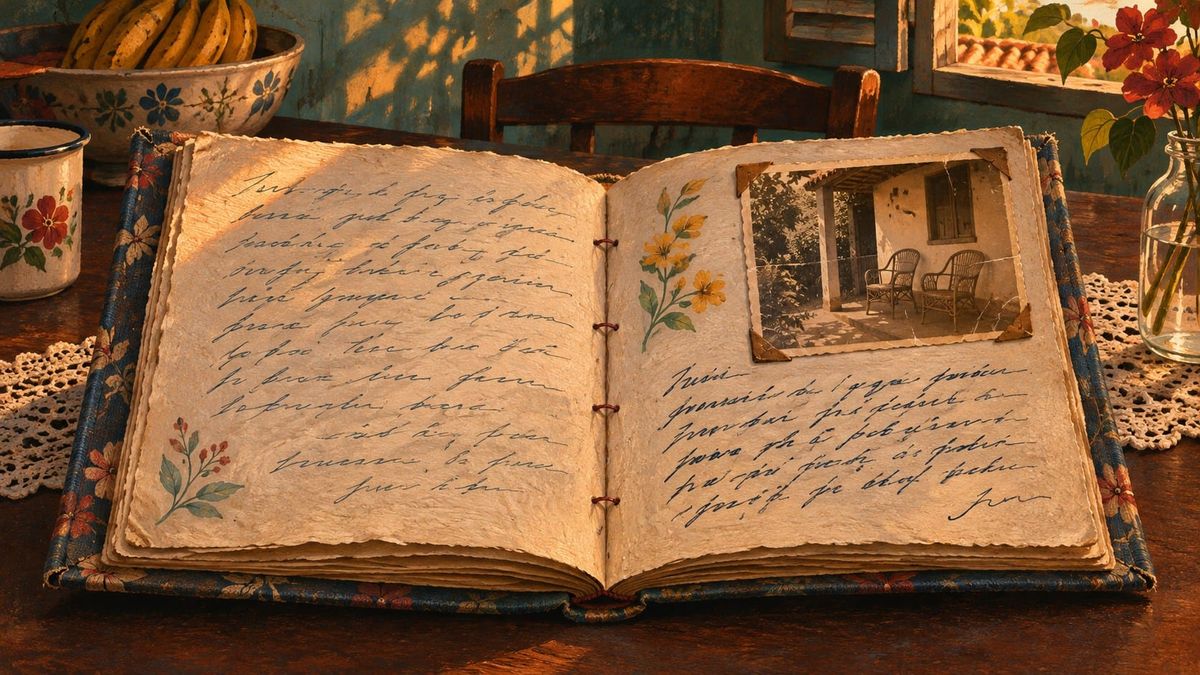
There is a page without a photograph in Jhonatan and Clara’s adventure book. The children had gone to sleep early. Their parents sat on the porch and talked. What Jhonatan wanted to keep from that evening would have escaped a camera even if someone had thought to bring one: sitting beside Clara, he had felt, for once, no wish to be anywhere else.
Clara reads the page three times before she writes her part. I want to stay with those three readings. She was on the porch too. She might have remembered the children, the hour, the conversation. What she could not have remembered was how it had felt to be Jhonatan that night. She learns something about an evening of her own life by reading about it afterward.
We often ask the person who was there with us to settle a detail. Was it raining? Were the children still awake? We want a second witness because we hope two imperfect accounts will yield one more accurate account. But no amount of comparing details would have given Clara what she finds on the page. She needed him to tell her. And the telling gives them a second occasion to remember: there was the evening on the porch, and there was the day she found out what it meant to him.
The couple have a rule for making the book. Jhonatan chooses the photographs and writes first. Then he passes the book to Clara. She adds what she saw from where she stood. They both sign. A family album usually gets by with one hand identifying the people in a picture. Two signatures seem almost comically formal for a record of a flat tire or a bad cup of coffee. Yet I like the formality. Each gets to say: I was there, and this is the part I can tell.
Consider what a single caption might do to the story of the flat tire. Years later, it is a good story. At the roadside, with no phone signal, they had little reason to think so. If the caption reads simply “our funniest trip,” whose afternoon has it kept? The person writing it may be remembering the pleasure of telling the story at dinner. The other may still remember the particular relief of discovering that someone had packed a snack. Both have the right day. Getting the date right scarcely begins to account for the difference.
It matters that Jhonatan and Clara begin this work while they still have the luxury of disagreeing. Later, Jhonatan’s memory becomes uncertain. It would be easy, reading backward, to turn every earlier pleasure into preparation for an illness. That would take something from them. They made the book because they enjoyed going places. They stayed up late reading it because one of them could still surprise the other with a detail from a trip both knew by heart.
When one person comes to depend on the other for more of the telling, a small change in grammar can make a great difference. Imagine Clara opening the book to the porch. “Do you remember?” would give Jhonatan a task at which he might fail. “May I read you what you wrote?” would give him something to listen to, and the freedom to say yes or no. These are two possible ways of reading the scene, not lines the characters speak. What interests me is the different place each question leaves for the listener.
Clara cannot remember being her husband. Even with his handwriting in front of her, she has no special access to what he feels as he hears it. She can, however, lend him her voice without taking over the word I. For the length of a sentence she can speak in the first person, and the sentence will still belong to him. Few ordinary acts of reading ask quite so much tact.
The novel leaves Clara’s words on the porch page unreported. We know that she read it three times and that her hand shook a little when she signed. I would leave her answer there. A reader can be admitted to the porch, to the album, even to the pause before the pen touches the paper. The last few lines were for Jhonatan.
Read Book I of Jhonatan and Clara’s story, especially chapter six, “The Adventure Book.”