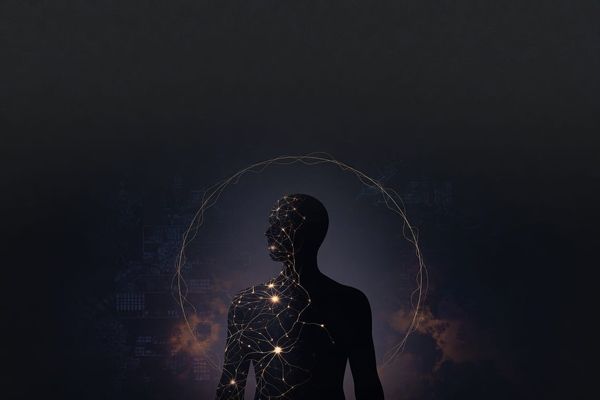
O Tempo Vivido é um privilégio Termodinâmico

Lived Time Is a
Thermodynamic Privilege
Why consciousness never accesses the present — and why that changes everything
The sun on your hand right now is the sun of eight minutes ago. The star you see in the sky may no longer exist. The universe that telescopes describe is not the present universe — it is the stratified archive of what already was, looked at from within, by an entity that also already was when it perceives.
I learned this not as abstraction — as clinical data. Those who work in emergency medicine learn early that the present is always a construction. What the patient feels now is always the processing of something the body already began without consciousness noticing. The delay is not pathology. It is the architecture of the nervous system functioning exactly as it should.
Libet demonstrated this formally in the 1980s: the brain initiates a movement before consciousness perceives the intention to perform it. What we experience as decision is the retrospective narration of a process that has already begun without us. Consciousness does not lead the present. It constructs it — from signals that arrived delayed — and calls that construction now.
This is not metaphor. It is verifiable physics.
The core claim: consciousness never accesses the physical present. It always accesses an entropically stabilized past. This delay is real, measurable, and irreducible. No training, attention, or technology eliminates it.
Here is the inversion that changes everything: consciousness does not exist despite the delay. It exists because of it. In the pure instant, without interval, there is no thought. There is only brute transformation — as happens in a black hole or a stone. The interval is the mechanism, not the limitation.
Delay is layered — a stratigraphy. Each layer carries those before it, each adding its own distance between the real instant and the conscious experience of that instant:
- Cosmological The photons powering your neurons took hundreds of thousands of years to leave the solar core. You arrive in the world already carrying that delay before having a single neuron.
- Biological The ATP firing the neuron that produces your thought right now traces back to a leaf that captured light from a star whose core generated it millennia ago.
- Neural Sensory signals travel at 1 to 120 meters per second. Your body arrives at your brain at slightly different times. What you call the present is already a synthesis.
- Perceptive Libet's interval, synthesis time, the construction of what consciousness calls now. The thinnest in absolute time. The most complex in organization.
Existence is the contact between the universe as process and consciousness as integration — a contact that is never simultaneous because absolute simultaneity is physically impossible. The entire universe operates in delay relative to itself.
Consciousness is the only part of the universe that noticed.
If no part of the universe can know what another part is doing now — because any signal carrying that information arrives delayed — then the absolute present does not exist as an accessible physical structure. Einstein demonstrated this formally. What remains when the absolute present is removed is the interval.
Between the real instant and its perception there exists a space that is not absence — it is the condition of possibility for everything we consider specifically human. Consciousness exists because there is an interval. The interval exists because the universe is asynchronous by structure — not by failure, but by being exactly the kind of universe where complexity can accumulate.
Lived time is not given.
It is thermodynamically won — instant by instant,
against the universal tendency toward disorder.
Consciousness is not alien to the universe. It is the universe in reflexive operation — at the only point where it accumulated sufficient order to ask itself what it is.
I work with the life and death of people with enough frequency to know this is not a beautiful phrase. It is a literal description of what happens when a human being manages to name its own condition — and transform that into something that endures beyond the instant that produced it.
Delay thinks about delay. The interval names the interval.
S. R. Malheiros Júnior · 2026